


/ Health Center
A place you can trust for urgent care, preventative care, and answers to your medical questions.
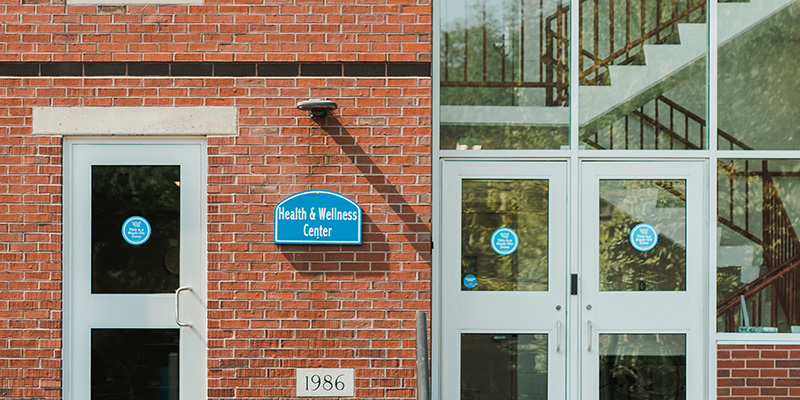


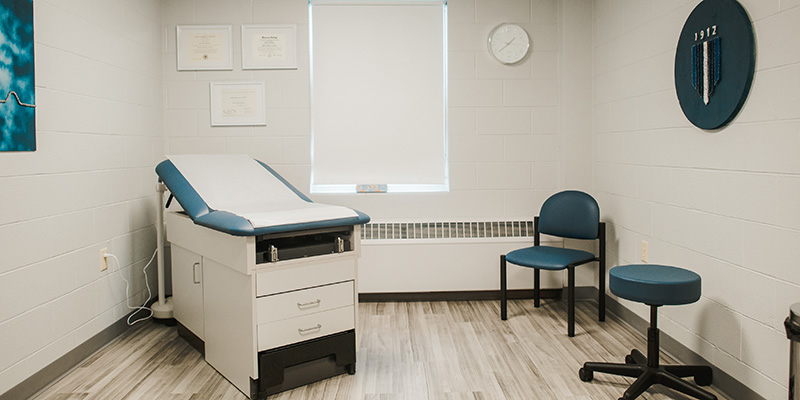
At the Saint Joseph’s College Health & Wellness Center, we’re committed to answering your questions and helping you get the care you need.
The Health and Wellness Center is located on the first floor of O’Connor Hall. When you enter campus, it is the first building on the right. In this new space, we have added 3 new exam rooms, a triage room, two quiet rooms, and a new lab.
We will still be offering all the same comprehensive services such as physical examinations, blood work, prescription refills, and any other needs you may have.
This year we will require that you set up an appointment in advance of coming to the Health Center. It is as easy as a few clicks from your cell phone or laptop to register for an appointment. We have time slots available every 15 minutes.
*You can set up your appointment here: https://sjc-health.titaniumhwc.com/
As always, if there is an emergency, and you need to be seen right away, please call our office at 207-893-6634. We will be open Monday – Friday 8:30am-4:30pm. For after hour emergencies, please contact Campus Safety at 207-893-7911.
Another feature we offer is Telehealth upon request. With Telehealth, you can stay in the comfort of your room and have an office visit online with one of our Health Center staff.
Health Forms
Maine State law requires written documentation on all students’ immunization history. Requirements are listed below and must be completed prior to coming to the college campus. In order to provide quality medical care while you are on campus, we require knowledge of your previous medical history and a current (within the past one year) pre-entrance physical exam by your physician. If you are chronically ill or take medication regularly, or if you are coming to Saint Joseph’s with an unhealed injury or problem, please ask your physician to send a complete report, including a treatment plan. If you are on regular medication, it is recommended that you bring a prescription for that medication with you to school so that it may be filled at a local pharmacy, if necessary. Most medications can be refilled by the Health and Wellness Center staff with appropriate follow-up appointments.
Student Health Insurance Program
In accordance with federal law and the College policy, all students must be enrolled in a form of health insurance. To this end, students are automatically enrolled in the Saint Joseph’s College Student Health Insurance Program for which a separate fee is charged, viewable on each student’s billing statement through Student Accounts.
All registered full-time students are required to complete the enrollment/waiver process annually. Students have the opportunity to request to waive the automatic Saint Joseph’s College Student Health Insurance Program, provided the student or family can provide proof of comprehensive private medical insurance coverage that pays for more than just emergency care in Maine. (It is important to understand health insurance coverage provided through a state assistance program (commonly known as Medicaid) from a state other than Maine will not offer non-emergency benefits while you are outside of your service area (living in Maine) and can’t be accepted as comparable coverage to waive the student health insurance.) Included are FAQ’s that may be helpful: https://www.crossagency.com/wp-content/uploads/2026/03/SJC-FAQ-26-27.pdf
Go to https://www.studentinsurance.com/Client/1526 regarding the Student Health Insurance Plan. The deadline to complete the process is July 17, 2026.
Frequently Asked Questions (FAQs)
At Saint Joseph’s College (SJC) Health & Wellness Center, we’re committed to answering your questions and helping you get the care you need. Students and families often wonder about what health services are offered on campus. Below we address some of the more commonly asked questions. If you still need more information, don’t hesitate to reach out to the Health & Wellness Center at healthcenter@sjcme.edu or by calling (207) 893-6634. We are happy to help.
Where is the Health & Wellness Center located?
We are located on the first floor of O’Connor Hall. This is the building just to the right as you enter campus and adjacent to Currier Hall.
What hours are the Health & Wellness Center open and how do I schedule an appointment?
Health services are provided by our Certified Nurse Practitioner and/or Certified Medical Assistant Monday through Friday from 8:30am-4:30pm. Making an appointment is easy and we offer both in-person and virtual visits. You can schedule a visit online, call (207-893-6634), email, or set up an appointment in person. Walk-ins are also welcome.
What if I get sick after the Health & Wellness Center is closed?
If you are experiencing a medical emergency, please call Campus Safety at extension 7911 or (207) 893-7911 from your cell phone.
If your condition is life-threatening, Campus Safety will contact Standish Fire/EMS for evaluation and transportation when needed. When emergency transport is necessary, you may specify your preference of the two area hospitals that provide 24-hour care:
Northern Light Mercy Hospital (35 min)
178 Fore River Parkway
Portland, ME 04102
207-879-3266 ER
207-879-3000 main #
Maine Medical Center (35 min)
22 Bramhall St
Portland, ME 04101
207-871-2381 ER
207-662-0111 main #
If you need to be seen outside of Health & Wellness Center hours, there are two local urgent care facilities that are open from 8am-8pm, 7 days per week. You need to provide your own transportation to these urgent care sites:
Northern Light Mercy Walk-in Care (10 min)
409 Roosevelt Trail
Windham, ME 04062
207-893-0290
MaineHealth Urgent Care (25 min)
335 Brighton Ave
Portland, ME 04101
207-662-8111
As a reminder, keep a copy of your health insurance card with you at all times.
What if I don’t have access to a car and require transportation to a quick-care or hospital for non-emergency care?
The College has partnered with “RTP Ride” to assist with transportation. You may schedule a ride online or by calling (207) 774-2666. There is no cost for students, but you will need to show your Saint Joe’s ID.
Who is eligible to use the Health & Wellness Center?
On-campus residential and commuter students who are currently enrolled are welcome to access Health & Wellness Center services.
What is the Health Facilities Fee?
Saint Joe’s understands that physical and psychological well-being are critical to a student’s success inside and outside of the classroom. Yet there are many barriers to accessing healthcare, including the availability of providers and, even with health insurance, the associated costs of deductibles, co-payments, and co-insurances expenses. The Health Facilities Fee ensures that the College can offer timely and convenient access to affordable physical and mental health care for SJC students.
What does the Health Facilities fee include?
The fee allows us to provide at no additional cost, mental health services through our Counseling Center, as well as unlimited Health Center office visits with our Certified Nurse Practitioner and/or Certified Medical Assistant, referrals to specialists, a wide variety of over the counter medications, limited prescription medications (antibiotics, eye drops, inhalers), first aid supplies, maintenance of allergy injections, nebulizer treatments, and other wellness education programming and health promotion.
Is there a charge or co-pay to be seen at the Health & Wellness Center?
As noted above, most services are included in the Health Facilities Fee (automatically billed to your student account).
There are some instances and/or procedures, though, in which your health insurance will be billed, including:
- Any service provided off-campus (ER visits, Specialist evaluations, X-Rays)
- Prescriptions obtained at the local pharmacy (however, we can write them for you at no cost)
- Lab work that is sent off-site for testing (blood testing, STD testing, Pap Smears, Throat Cultures)
- Vaccinations
- Covid Tests
- Rapid Strep Test
- Influenza Test
- Cryosurgery (wart/lesion removal)
- Complete physical exams and sports physicals.
In such cases, individuals are responsible for balances not covered by health insurance.
Do I need health insurance to be seen at the Health & Wellness Center?
Although most of the services rendered at the Health Center are covered by the Health Facilities Fee, in accordance with federal law and College policy, all students must be enrolled in Affordable Care Act compliant health insurance.
I am on a daily prescription medication that will require a refill monthly. Can I get the prescription for the refills through the Health & Wellness Center?
Yes! For your convenience, our Nurse Practitioner is happy to work with your primary care doctor and write refill prescriptions for your routine medications. Your prescription can be sent to one of the below local pharmacies (all within 5 miles of campus):
- Walgreens (207) 893-2562
- CVS (207) 892-2541
- Hannaford (207) 892-8571
- Walmart (207) 893-0654
Is my medical information confidential?
Yes, by law and by regulations set forth by the Health Insurance Portability and Accountability Act (HIPAA), your medical information is confidential. Outside of medical emergencies (including threats of harm to self or others) or when otherwise required by law, your medical information cannot be legally disclosed to anyone without your consent. Neither do your medical records become part of your student records.
NOTE: If your health insurance is billed during a visit to the Health & Wellness Center (labs, x-rays, prescriptions), your insurance provider may send an Explanation of Benefits (EOB) to the policy subscriber, often a parent. It is important for you to call the customer service number on your insurance card to ask what their EOB procedure is if confidentiality is a concern.
Do I need a parent’s permission to be seen or treated at the Health & Wellness Center?
Students 18 years or older, as well as college students who are minors and living separately from a parent(s), do not need parental consent to receive medical services.
I cannot register for classes because I have not submitted my immunization records. Can you lift my hold?
Maine State law requires written documentation of immunization history for all of our students. The Health & Wellness Center places holds on student accounts when students have not provided the required immunization documentation. If there is a hold on your registration, you should contact the Health Center at (207) 893-6634 to determine which documentation we are missing. All registration holds are temporary until a student brings us the documentation to verify missing vaccinations.
I missed class because I am sick. Can you write me a note to excuse my absence from class?
If you are sick, you should notify your professor in the manner instructed on your course syllabus prior to missing a class or as soon as reasonably possible.
At your request and with your consent, the Health & Wellness Center will provide documentation to verify the date you were seen for an appointment for a reported illness, but no further information will be provided.
It is at the discretion of the professor as to whether such documentation is adequate to support the absence and whether your absence will be excused.
When medical conditions require hospitalization or isolation (such as those involving a communicable disease), the Nurse Practitioner may recommend that a student not attend class for a specified time period. In these circumstances, the Health & Wellness Center will notify the Office of Academic Affairs of your advised absence from class. No additional information will be disclosed.
Who should I talk to about a medical bill if I’m concerned about cost of service or an insurance bill I have received?
You can call the Health & Wellness Center at (207) 893-6634 and request to speak to Doreen Webber about your bill. We also utilize Physician Billing and Consulting as our billing service. They can be reached at (207) 777-5370.
If you are enrolled in the College Health Insurance Plan, you may also contact Cross Insurance at (207) 783-8591.
Meet the Staff
Sheri Piers, ANP-C
spiers@sjcme.edu
Sheri is a board certified adult nurse practitioner who serves as the health and wellness director at SJC. Sheri is in the office to see students Monday through Friday. She is also involved in many educational and health promotion activities on campus.
Jenna Chase
Associate Director of Health and Wellness
jchase@sjcme.edu
Luanne Mageles, CMA
lmageles@sjcme.edu
Luanne is in the office daily to triage students, assist with general medical care, set up appointments for students to see our providers and assist students with most all of their medical needs.
Doreen Webber, Adm. Assistant
dwebber@sjcme.edu
Doreen is in the office daily to help students with insurance questions and schedule appointments. She is also responsible for tracking all immunizations and medical forms which are required by state law.
Contact Us
Location: O’Connor Hall
Phone: 207-893-6634
Fax: 207-893-7865
healthcenter@sjcme.edu
Hours
Mon-Fri: 8:30am-4:30pm