Marine Science, Marine Biology, B.S.

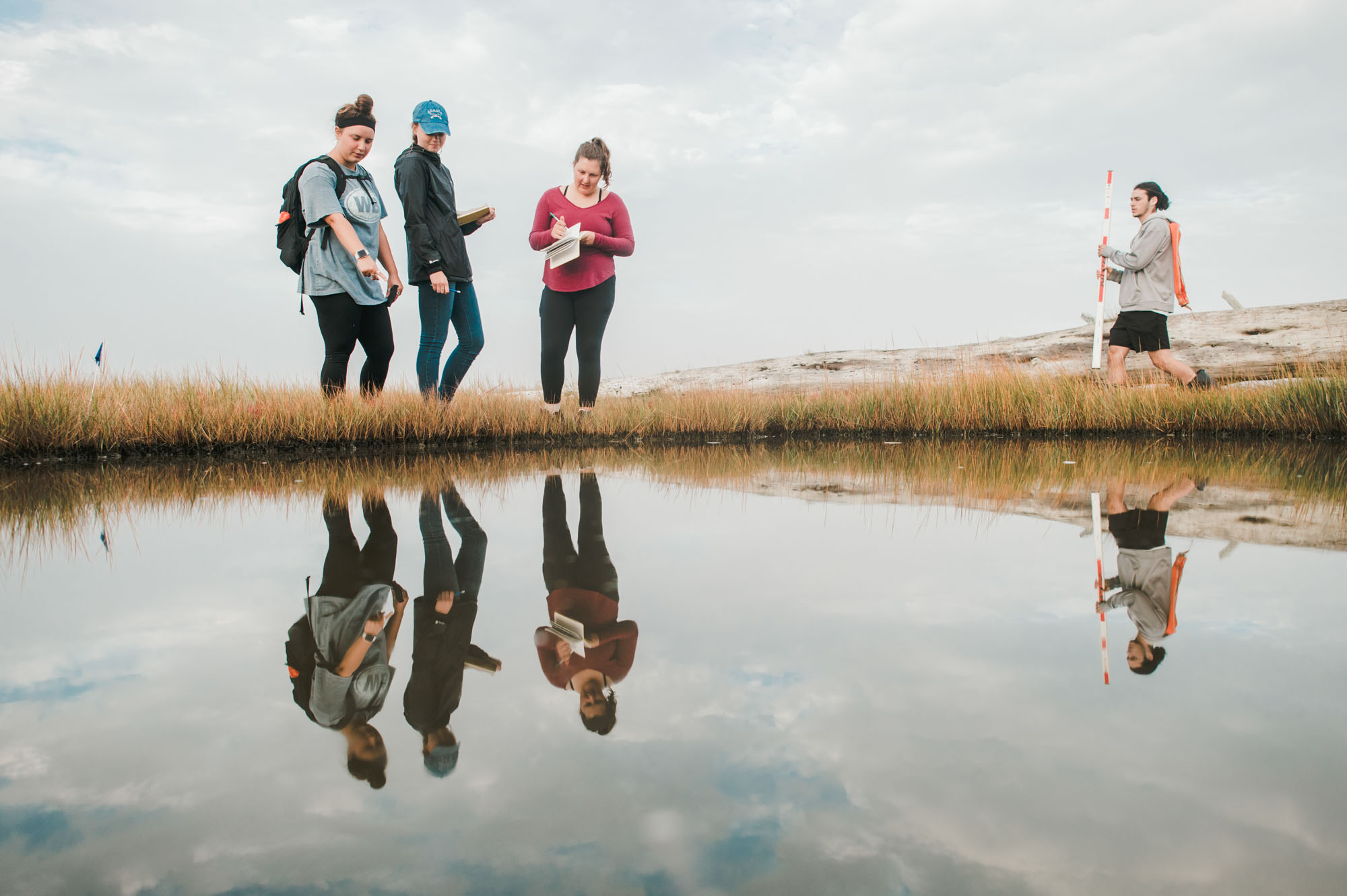
Three marine biology students take notes at the edge of a pond while a fourth person holds a surveying rod nearby, all reflected in the water. Saint Joseph's College of Maine

Marine Science, Marine Biology, B.S.

Develop a Molecular-to-Ecosystem Understanding of Life in Our Oceans

Program Overview

The Marine Science, Marine Biology major guides students through investigations of the geological, physical, chemical, and biological characteristics of ocean systems as well as training them on the marine, estuarine, and fresh waters of Maine. There is a heavy emphasis on field work ensuring that students spend ample time learning the discipline in stimulating locations such as the rocky coast, mudflats, estuaries, the sea floor, even the open waters of the Gulf of Maine.

Students studying Marine Biology focus on specialized electives that explore marine life, complex aquatic ecosystems, and the intricate interactions of marine organisms with their changing environment. By integrating advanced coursework in cellular biology, ecology, physiology, and oceanography, students develop a molecular-to-ecosystem understanding of life in our oceans.

Why Choose the Marine Science Program at SJC?

  • Direct Access to the Gulf of Maine: Our location provides a literal living laboratory right outside your door. You won’t just read about estuarine dynamics or marine ecology; you will measure, sample, and observe them firsthand.
  • Comprehensive Training: The Marine Biology track pairs foundational physics and chemistry with deep biological specialization. This dual lens ensures you understand both the organism and the environment sustaining it.
  • Mentored Research Capstone: Take advantage of advanced undergraduate research options (BI 406/407). Work side-by-side with faculty mentors to design, execute, and write a formal thesis—the ultimate differentiator for competitive graduate school applications.

Flexible Learning Options

  • On-Campus featuring comprehensive, boots-on-the-ground field and laboratory coursework.

  • Experiential Credit Opportunities (Mode 3): If you possess prior marine or environmental experience, or want to build a custom field project, you can collaborate with a faculty sponsor. This pathway allows you to secure 3 to 4 academic credits toward your Core Curriculum through a tailored experiential portfolio.

A group of marine biology students walks across a wet, sandy beach reflecting the sky and their figures in shallow pools of water. Saint Joseph's College of Maine

Key Faculty Expertise

Program Details

Program Cost

  • Comprehensive Institutional Value: Traditional financial aid, undergraduate scholarships, and field equipment access are bundled directly into your undergraduate package.

  • Immersive Coastal Classrooms: Swap lecture halls for raw field work across Maine’s rocky intertidal zones, expansive mudflats, active estuaries, Sebago Lake, and the open waters of the Gulf of Maine.
  • Organismal & Ecosystem Focus: Explore how marine organisms thrive, adapt, and interact with environmental pressures through targeted tracks in physiology and behavior.
  • Professional Research Integration: Graduate ready for the field by mastering the scientific method, independently proposing questions, designing experimental procedures, and handling real data sets.
  • Maximize Your Credit Efficiency: Saint Joseph’s College Curriculum is designed to help you get the most out of every course. Key foundational classes for your major, like Calculus and Ecology and the Environmental Challenge, seamlessly satisfy Core major requirements helping you meet the college-wide 120-credit graduation standard without taking extra classes. To lay a strong foundation, all first-year students begin their journey with the First Year Experience (FYE) Seminar.
  • Prior Learning Experience: Earn 3 to 4 core credits by converting planned or prior field experiences such as marine sanctuary volunteering, commercial fisheries work, or coastal conservation internships, into an official academic portfolio.

Curriculum & Course Requirements

To ensure you are viewing the exact, certified curriculum metrics for your academic period, please refer directly to our academic catalog.

The Marine Biology curriculum balances broad environmental science methodologies with intense organismal lab and field blocks.

Foundational Major Core

  • BI 120 & 121: Introductory Biology I & II (SR)
  • CH 130 & 131: Principles of Chemistry I & II (CBL-R)
  • CH 220: Survey of Organic Chemistry (CBL-R)
  • ES 100: Ecology and the Environmental Challenge (CBL-R) (SF)
  • ES 105: Introduction to Oceanography (SF)
  • ES 120: Field Research Methods in Environmental Science (SF)
  • ES 125: Environmental Data Analysis
  • ES 301: Seminar in Environmental Science (SR)
  • MA 201: Calculus I
  • Choose One: BI 233: Ecology or BI 325: Ornithology (SR)

Marine Biology Track Requirements (16 credits)

  • BI 209: Estuarine & Marine Biology
  • BI 406 & 407: Seminar and Research Thesis (Optional)
  • Choose Three (3) Track Electives:
    • BI 209: Animal Behavior
    • BI 245: Cellular Biology
    • BI 335: Fisheries Oceanography (SF)
    • BI 345: Animal Physiology
    • ES 240: Marine Ecology (SF)
    • ES 260: Aquaculture (SR)
    • PC 120: Physics I – Mechanics

Admissions & Application Process

  • Rolling Admissions Framework: SJC evaluates undergraduate applications throughout the year, allowing you to secure your spot early.

Key Enrollment Dates

Align your enrollment window with our seasonal field research cycles:

  • Fall semester
  • Spring semester

Student Stories

Amanda Darby ’23

“Rather than learning from a classroom or online, (during Environmental Science Semester) we learned on the beaches of Cape Cod, at the top of Mount Washington, and sailed on a schooner up the coast of Maine.”

Amanda Darby ’23

Marine Science, Environmental Science

Shaylee Davis ’21

"I'm conducting lake sediment chemistry experiments for the Long Pond Association to determine if the amount of phosphorus in a local lake is detrimental to the natural ecosystem. The LPA's goal is to acquire a permit to mitigate algae problems. This research can have a large impact on our environment, if applied widely, to combat the growing prevalence and problem of lake phosphorus."

Shaylee Davis ’21

Environmental Science + Marine Science

Career Opportunities After Graduation

Graduates from the Marine Biology track possess the field adaptability, laboratory precision, and analytical skills required for diverse roles across the private, public, and non-profit sectors:

  • Marine Mammal or Wildlife Biologist: Monitor populations, study behavioral patterns, or assist with rehabilitation networks for regional conservation groups.
  • Aquaculture Field Technician: Design, maintain, and optimize sustainable systems for commercial kelp, shellfish, or finfish facilities.
  • Coastal Restorations Specialist: Partner with non-profits or state agencies to rebuild compromised marshes, clean up estuaries, and track invasive species.
  • State or Federal Fisheries Observer: Gather critical catch-and-effort data directly aboard commercial vessels for agencies like NOAA or state wildlife departments.
  • Ecotourism & Marine Educator: Translate complex aquatic science into engaging public programming for aquariums, nature centers, or coastal preserves.
  • Advanced Graduate Studies: Transition smoothly into specialized Master’s or Ph.D. pathways in Organismal Physiology, Marine Ecology, Conservation Biology, or Biological Oceanography.
Three Marine Science students walk through a misty, marshy field carrying survey equipment. Saint Joseph's College of Maine