Marine Science, Oceanography, B.S.

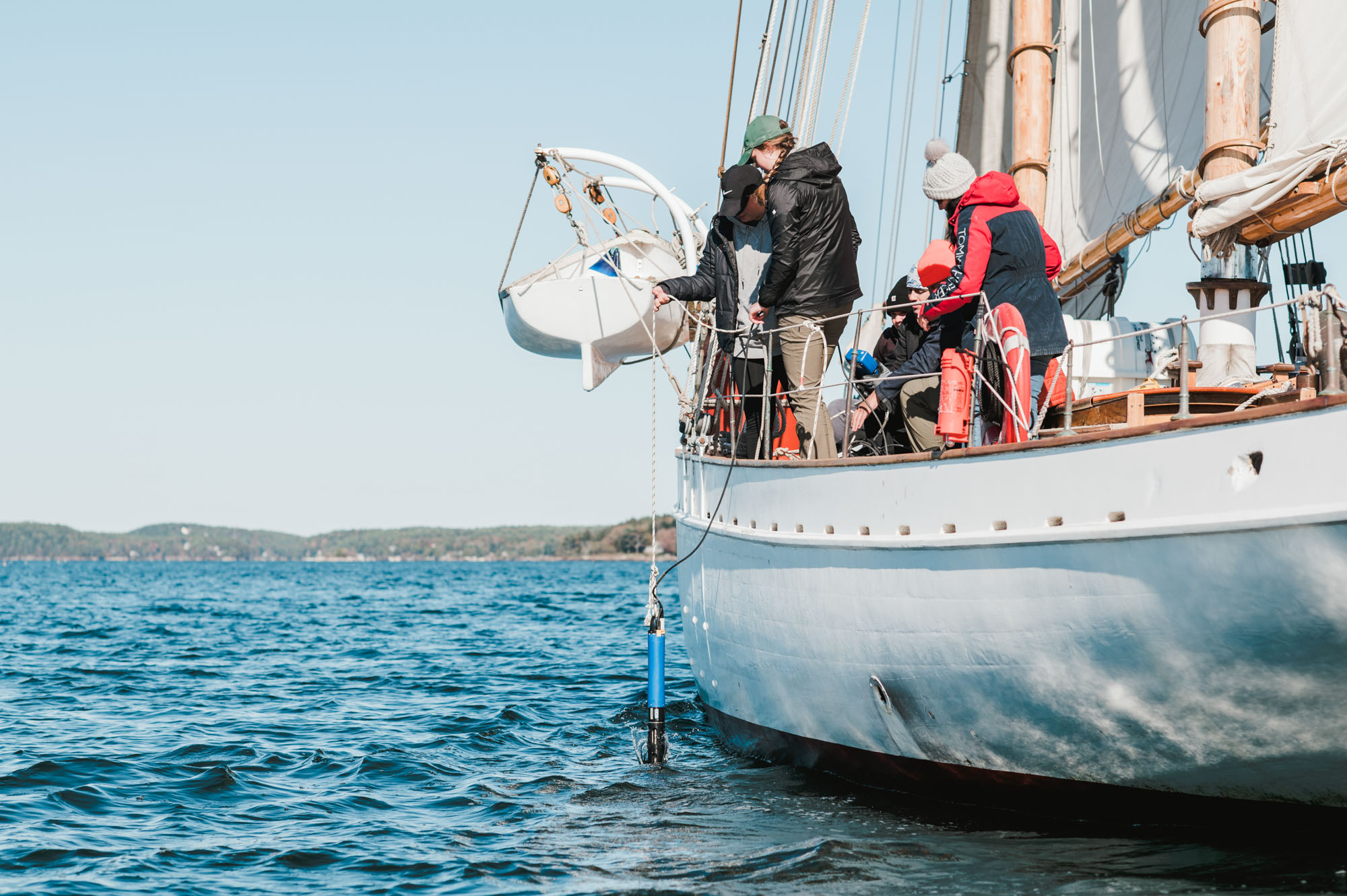
Marine science students on the deck of a sailboat lowering a blue sensor instrument into the water. Saint Joseph's College of Maine

Marine Science, Oceanography, B.S.

Dive Deep Into Ocean Systems

Program Overview

The Marine Science, Oceanography major guides students through investigations of the geological, physical, chemical, and biological characteristics of ocean systems as well as training them on the marine, estuarine, and fresh waters of Maine. There is a heavy emphasis on field work ensuring that students spend ample time learning the discipline in stimulating locations – the rocky coast, mudflats, estuaries, the sea floor, even the open waters of the Gulf of Maine.

Students studying oceanography will focus on electives that explore the ocean’s physical properties, marine life, and interactions with the atmosphere and land. They will do so by taking courses in chemistry, geology, biology, and physics.

Why Choose the Marine Science Program at SJC?

  • Maine as Your Natural Laboratory: Our geographic positioning gives you unmatched access to complex marine and freshwater systems. You will spend less time in traditional lectures and more time getting your boots muddy and pulling up data from the Atlantic.
  • True Quantitative Readiness: The Oceanography track builds powerful cross-functional competencies by blending pure lab sciences with advanced environmental data analysis, making you highly competitive for top graduate programs and environmental consulting firms.
  • Intentional Faculty Mentorship: Benefit from small classes and direct collaboration with active field researchers. Our 1:10 student-to-faculty ratio means you receive personal guidance when drafting research proposals, analyzing data, and navigating career paths.

Flexible Learning Options

  • On-Campus with Extensive Immersive Fieldwork: At Saint Joseph’s College, our direct access to Sebago Lake and surrounding freshwater ecosystems allows students to master industry-standard marine and estuarine field methods just steps from the classroom. You’ll gain hands-on, practical research experience across multiple courses, preparing you for dynamic careers in environmental science and oceanography from day one.

  • Experiential Credit Opportunities (Mode 3): If you have prior real-world environmental learning or want to design a custom field project, you can work with a faculty sponsor to earn 3 to 4 academic credits toward your Core Curriculum through a curated experiential portfolio.

A person writing in an oceanography notebook filled with handwritten notes and a graph. Saint Joseph's College of Maine

Key Faculty Expertise

Program Details

Program Cost

  • Comprehensive Institutional Value: Financial aid packages, scholarships, and field lab resources are bundled directly into your traditional undergraduate structure.

  • Immersive Fieldwork: Learn directly on the water, exploring Maine’s rocky coastlines, tidal mudflats, active estuaries, and the deep waters of the Gulf of Maine.
  • The Physics & Chemistry of Oceans: Dive deep into the physical mechanisms governing marine life, currents, climate interactions, and sea-floor geology.
  • Rigorous Undergraduate Research: Build professional-grade skills by independently proposing scientific questions, designing experiments, and executing field-based research data sets.
  • Maximize Your Credit Efficiency: Saint Joseph’s College Curriculum is designed to help you get the most out of every course. Key foundational classes for your major, like Calculus and Ecology and the Environmental Challenge, seamlessly satisfy Core major requirements helping you meet the college-wide 120-credit graduation standard without taking extra classes. To lay a strong foundation, all first-year students begin their journey with the First Year Experience (FYE) Seminar.
  • Prior Learning Experience: Earn 3 to 4 core credits by converting planned or prior field experiences such as marine sanctuary volunteering, commercial fisheries work, or coastal conservation internships into an official academic portfolio.

Curriculum & Course Requirements

To ensure you are viewing the exact, certified curriculum metrics for your academic period, please refer directly to our academic catalog.

The Marine Science major balances lab skill development with highly specialized data collection and track electives.

Foundation Major Core Courses

  • BI 120 & 121: Introductory Biology I & II (SR)
  • CH 130 & 131: Principles of Chemistry I & II (CBL-R)
  • CH 220: Survey of Organic Chemistry (CBL-R)
  • ES 100: Ecology and the Environmental Challenge (CBL-R) (SF)
  • ES 105: Introduction to Oceanography (SF)
  • ES 120: Field Research Methods in Environmental Science (SF)
  • ES 125: Environmental Data Analysis
  • ES 301: Seminar in Environmental Science (SR)
  • MA 201: Calculus I
  • Choose One: BI 233: Ecology or BI 325: Ornithology (SR)

Oceanography Track Requirements (16 credits)

  • ES 215: Limnology (SF)
  • ES 420: Senior Research I (Optional)
  • Choose Three (3) Track Electives:
    • CH 240: Analytical Chemistry (CBL-R) (SR)
    • CH 245: Environmental Chemistry (CBL-R) (SF)
    • ES 240: Marine Ecology (SF)
    • ES 250: Interpretation and Communication of Environmental Data (SF)
    • ES 260: Aquaculture (SR)
    • ES 335: Fisheries Oceanography (SF)
    • PC 120: Physics I – Mechanics
    • PC 121: Physics II – Electricity & Magnetism

Admissions & Application Process

  • Rolling Admissions Framework: We accept applications year-round for our rolling undergraduate admissions.

Key Enrollment Dates

Position yourself for early field placement by coordinating your entry window:

  • Fall semester
  • Spring semester

Student Stories

Amanda Darby ’23

“Rather than learning from a classroom or online, (during Environmental Science Semester) we learned on the beaches of Cape Cod, at the top of Mount Washington, and sailed on a schooner up the coast of Maine.”

Amanda Darby ’23

Marine Science, Environmental Science

Shaylee Davis ’21

"I'm conducting lake sediment chemistry experiments for the Long Pond Association to determine if the amount of phosphorus in a local lake is detrimental to the natural ecosystem. The LPA's goal is to acquire a permit to mitigate algae problems. This research can have a large impact on our environment, if applied widely, to combat the growing prevalence and problem of lake phosphorus."

Shaylee Davis ’21

Environmental Science + Marine Science

Career Opportunities After Graduation

Graduates from the Oceanography track possess the analytical skills, quantitative baseline, and technical writing capabilities needed for high-demand careers across marine and atmospheric sectors:

  • Oceanographic Research Assistant: Work with state, federal, or university labs tracking ocean temperatures, current patterns, and marine chemical mapping.
  • Environmental Consultant: Assess coastal development footprints, run environmental impact reports, and monitor water purity standards for corporate or municipal clients.
  • Fisheries & Aquaculture Specialist: Direct data operations, population metrics, or sustainability protocols for state or federal fisheries regulatory agencies and aquaculture facilities.
  • Climate & Meteorological Analyst: Study the complex interface between ocean systems and the atmosphere to track broader climate trends.
  • Graduate School Pathways: Seamlessly transition into Master’s programs in Chemical Oceanography, Marine Geology, Environmental Law, or Climate Science.
A white sailboat with tall masts and white sails underway on the oceanographic waters, viewed from the side deck. Saint Joseph's College of Maine