Saint Joseph’s College Announces Launch of Institute for Local Food Systems Innovation with $4 million in Funding

Saint Joseph’s College of Maine announced at a press conference today its launch of the Institute for Local Food Systems Innovation–a strategic partnership with federal, regional, and local governments, as well as corporations and individuals–that pursues the College’s long-standing initiatives in sustainability and community engagement, while contributing solutions to Maine’s need to recover manufacturing jobs, develop the state’s food and beverage industry, and meet regional food security goals.

U.S. Representative Chellie Pingree, on behalf of Maine’s Congressional delegation, announced that funding includes a $1,987,512 Public Works Construction Project award from the U.S. Department of Commerce’s Economic Development Administration to provide for the Institute’s infrastructure.

“The Institute will fill key needs to strengthen our food system and grow our economy in Maine…The Institute will support the creation of new jobs and a strengthened economy, which is perfectly in line with Greater Portland region’s goals of doubling the region’s food manufacturing employment in 10 years,” said Pingree.

In addition, a $500,000 gift from the Hannaford Charitable Foundation, a $750,000 award from Organic Nutrition, Inc. and donations from several private foundations and individuals, collectively, match the nearly $2 million EDA funding.

The $4 million in funding will allow the College to begin the first phase of its development: construction of a ¼ acre hydroponic greenhouse, a 3400 S.F. commercial kitchen, a livestock barn, connection to the municipal water system, and a biomass boiler system. The Institute will encompass five enterprises–a food manufacturing incubator, a hydroponic farm, a traditional crop and livestock farm, an agritourism event center, and an entrepreneurship development and education program offering certificates in areas such as hydroponic farming, food processing, and food merchandising.

Saint Joseph’s College President James Dlugos, Ph.D. said, “Our strategic plan identifies local, sustainable food production and distribution as a place where our skills as educators, as conveners, and as advocates for the environment, positioned us to address some of Maine’s most pressing economic and workforce preparation needs. The Institute for Local Food Systems Innovation allows us to be an even greater economic catalyst for the Sebago Lake Region and Maine than we already are.”

According to an economic impact analysis conducted by 45 North Research, the Institute is projected to impact the regional economy with a total net gain of $16.1 million in output, $4.1 million in earnings, and 135 jobs during construction and operation. According to the report, of the Institute’s five enterprises, the food incubator will have the largest long-term economic impact as it helps home-based food businesses scale up their operations.

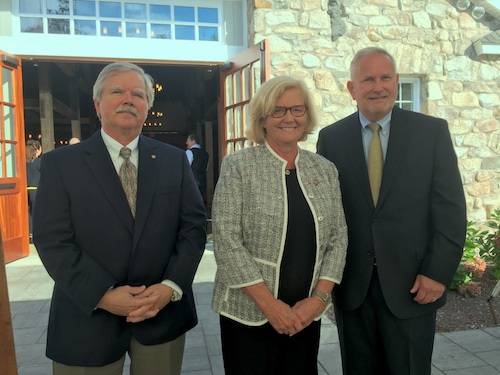
Three formally dressed individuals, two men and one woman, stand outside a stone building with wooden doors at Saint Joseph’s College. They are all smiling at the camera, celebrating the Institute for Local Food Systems Innovation’s recent $4 million in funding. Saint Joseph's College of Maine

A significant amount of the Institute’s economic impact will be generated by replacing products once purchased outside the region with products made locally. The Institute’s economic impact hinges largely on its ability to generate unique products and services that complement, not compete, with the region’s existing farms and retailers. Strong partnerships with local farms and food retailers will be essential to maximize the economic potential of the Institute.

College officials said the next phase of the work begins with building the educational programming and infrastructure desperately needed to support entrepreneurial ventures in this sector. The college will finalize architectural plans for the buildings and break ground for the hydroponic greenhouse in 2018. The public offering of the first competency-based courses and certificate programs in hydroponic food production is projected for fall 2018. Appearing in photo, left to right, are Alan Brigham (U.S. Economic Development Administration), U.S. Representative Chellie Pingree (D-Maine), and President Jim Dlugos, Ph.D. (Saint Joseph’s College).

This video message from Senator Angus S. King aired at the press conference.